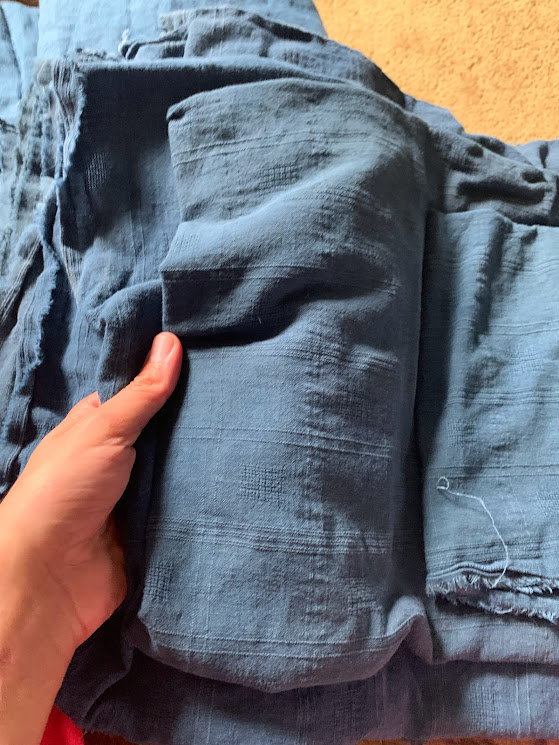
One of the most common questions I get about fabric dyeing is “How do you get the color so even?”.
My colors were splotchy for a long time! So I understand the frustration. In this short post, I’ll go over things I do to keep immersion dyed fabric even. As a note, I dye pretty much exclusively on plant fibers, though many of the same principles apply to proteins.

Use high quality dyes
I don’t use RIT or iDye. I use Procion MX dyes, which are professional dyes that react with the fiber to form a permanent bond. If I have to dye thread to match, I buy a seperate packet of synthetic dye to match, and do that step after. I buy my dyes from Dharma.
Test Your Pieces
If you’re dyeing something large or expensive, test on a small 1/2 yard swatch first – enough to catch errors, but not so big you’ll have a big loss. Dye is unpredictable. NEVER dye something you can’t afford to lose.
Prepare your fabrics properly
No matter what the manufacturer claims about the fibre being “prepared for dyeing”, wash and scour it first. I use synthraprol almost exclusively, but if it’s old or smelly fabric, I usually do one wash to “clean” with tide hygenic and borox first.
If you’re dyeing garments, this still applies.
Also, check fiber content! Blends with synthetics and proteins tend to heather, and thread is almost always polyester, which will need a second dye bath in a polyester dye bath. Try to buy blanks with cotton thread if possible.
If you have old, vintage garments, temper your expectations. Usually these have oils and stains that take a lot of effort to get out. It might be more effort, or be impossible, to get a truly even dye on old fabrics.
Give the fabric space
You need more water than you think you do. In general, I use 3-4 gallons of a 5 gallon bucket for something as small as a t-shirt or two. The fabric needs to be able to float freely.
If I’m dyeing a few meters of fabric, I have 15-20 gallon rope handle tubs I got from Target and Walmart.
If I need to dye more than about 3 meters of fabric, I start cutting the fabric up into smaller pieces.
If the fabric has to be scrunched up or doesn’t easily move in the water, use a larger tub. If you don’t, you will get speckling and fold lines.
Actually follow the instructions
Really do follow the instructions, even the annoying parts. For reference, here are the Procion instructions from the Dharma website.
As a note, I never use a washing machine. It seems too risky and kinda messy on a very expensive Speed Queen. I’ve always dyed in a tub. I have never needed a washing machine to get even color.
Measure with a scale
I always measure with a scale for the dye itself, unless I’m doing a lazy one-off t shirt or something. I use the table here. I also am careful to use an accurate scale – it doesn’t have to be fancy. This is the one I prefer.
Dissolve and strain ingredients
When I mix up dye, I have a big pitcher of hot, hot water, and a whisk. I dissolve everything thoroughly with the hot water. For dye, I have a fine mesh strainer that I filter all dissolved dye through as I pour it into the vat.
For salt, I use pickling salt. I try to make sure the tub water is warm, by leaving it in the sun, so that when I pour in the salt, it dissolves well. If it’s really cold, I’ll get a lot of hot water and make a salt-slurry before I pour in the salt.
The soda ash I also dissolve in hot water, and I always move the fabric to the side when I add it. I’ve personally never needed to add it gradually like the instructions say.
Stir, Stir, Stir
I have a long stick of bamboo and I stir the fabric thoroughly with it, and I go back to it every five minutes while the fabric sits in the vat and stir it for a minute or two. If I have to, I use gloves to expose every fold to the dye evenly.
Generally, I leave fabric in an hour to an hour and a half. I NEVER leave fabric in the vat if I’m not going to stir it – I always keep it moving.
If the washing machine is occupied when the vat is done, I rinse out the fabric and hang it up. I never leave it. Although people will say the reaction has finished after an hour or so, I have successfully dyed lighter shades with expired vats an hour or two after they were done, so I don’t leave fabric in them to rest.
Lather, Rinse, Repeat
After the vat is done, I promptly wash it with synthraprol in warm to hot water. If, for whatever reason, the dye didn’t come out even, I repeat the process. Sometimes, with some colors, it takes two coats of dye. If it’s still not going well, I’ll darken the shade a touch, and try again, two more times.
If it’s still not working, then it becomes a lining fabric or a work clothing fabric. This is an important lesson: never dye fabric you can’t afford to lose, and always test with a small (1/2 yard) piece first.
Also Nell