
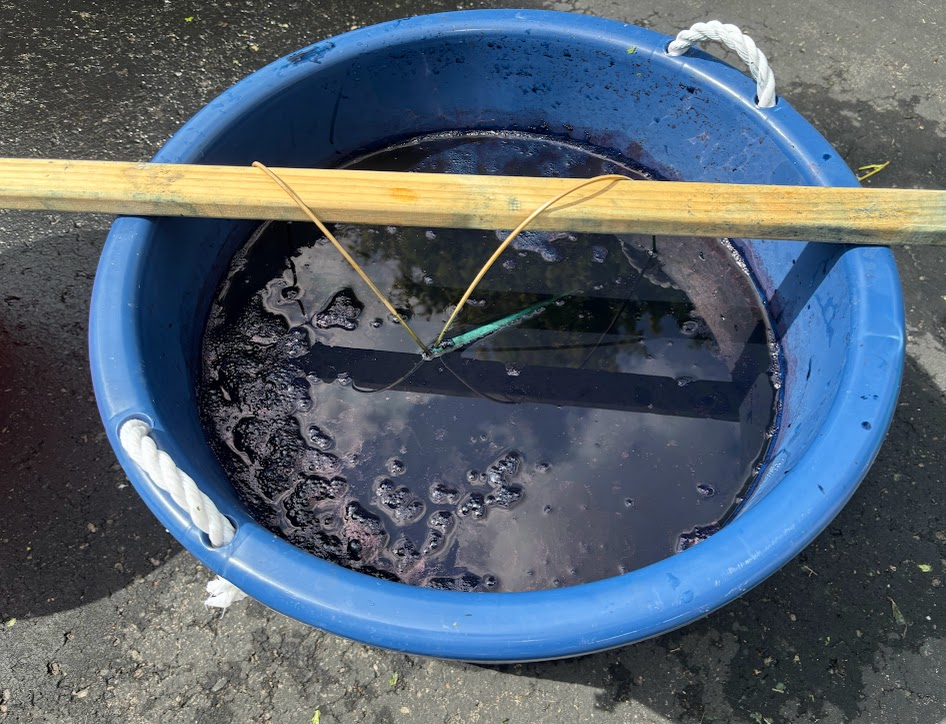
Since the weather has gotten warmer and drier, I’ve had the opportunity to do further experiments on the best processes for double sided indigo. I based my experiments on traditional processes found in a book I really enjoy, 日本の手わざ 長板中形, and conversations with my friend Skye at https://www.instagram.com/indigoblueskye/.
Understand that these are not my best work or representative of something I would make for another person. They’re experiments, and the errors are part of the process. Mistakes made as part of trials allow me to learn and improve. If my trials were flawless, it would be a sign I wasn’t challenging myself enough. I usually only have error free trials with the final swatch test before making a larger piece.
I did about five trials, and originally had them all in one post, but it was perilously long for the age of Tik Tok and Instagram. I have broken them apart so I can give each one proper attention.
My first experiment: Does it have to be double sided?
Because my first introduction to paste resist with indigo was through historical research, it never occurred to me that I should try pasting only one side of the fabric. And I should have thought of it, because there are medieval historical examples of this in Japan; I was just fixated on reproducing the Chayazome process.
As it turns out, this method is much easier and can be used for interesting aesthetic effects, especially if you do a pattern like leaves and have different resists mismatched on each side. But if you just do one side, you get a milky translucent white instead of a clear white, which is beautiful on its own.
Here’s a historical example of a single sided resist, owned by Tokugawa Ieyasu.
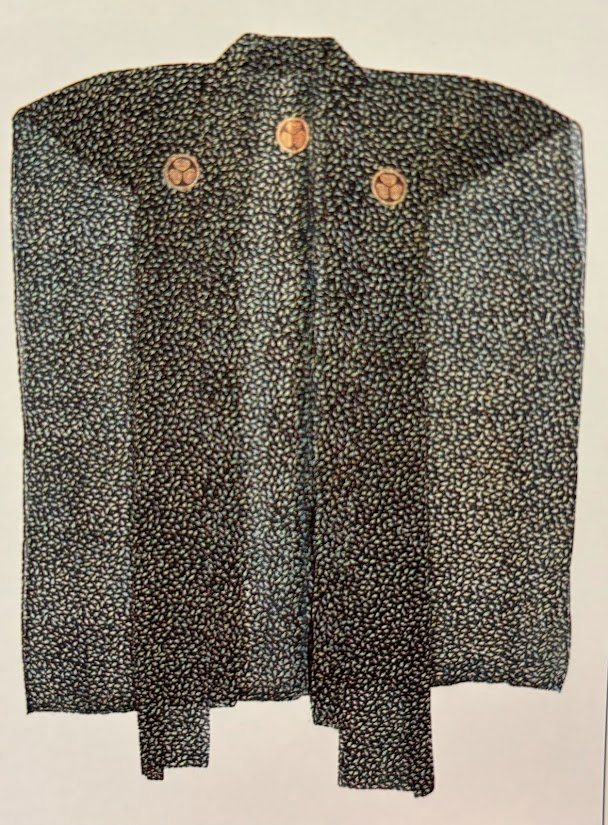
17th Century
Tokugawa Art Museum

And here is the famous crab robe yukata, also worn by Tokugawa Ieyasu. It is double sided.

Momoyama to Early Edo
Tokugawa Art Museum
View at Google Arts & Culture

Especially with thin bast fabrics, it’s hard to tell what is double or single sided without being up close in person, and harder still when the garment is over 400 years old. In general, the double sided resist makes a clean, pure white, while single sided resist has a milky blue white on one side and a lighter blue on the other.
I did my own experiments so you can understand the difference. All of these are dyed in a synthetic indigo (Jacquard) vat reduced with thiox (thiorea dioxide purchased from PRO Chemical and Dye). When I do trials that aren’t vat dependent like this one, I often use synthetic indigo because it keeps the cost economic for experiments.
This is what a double sided resist looks like on silk habotai, 16 momme:

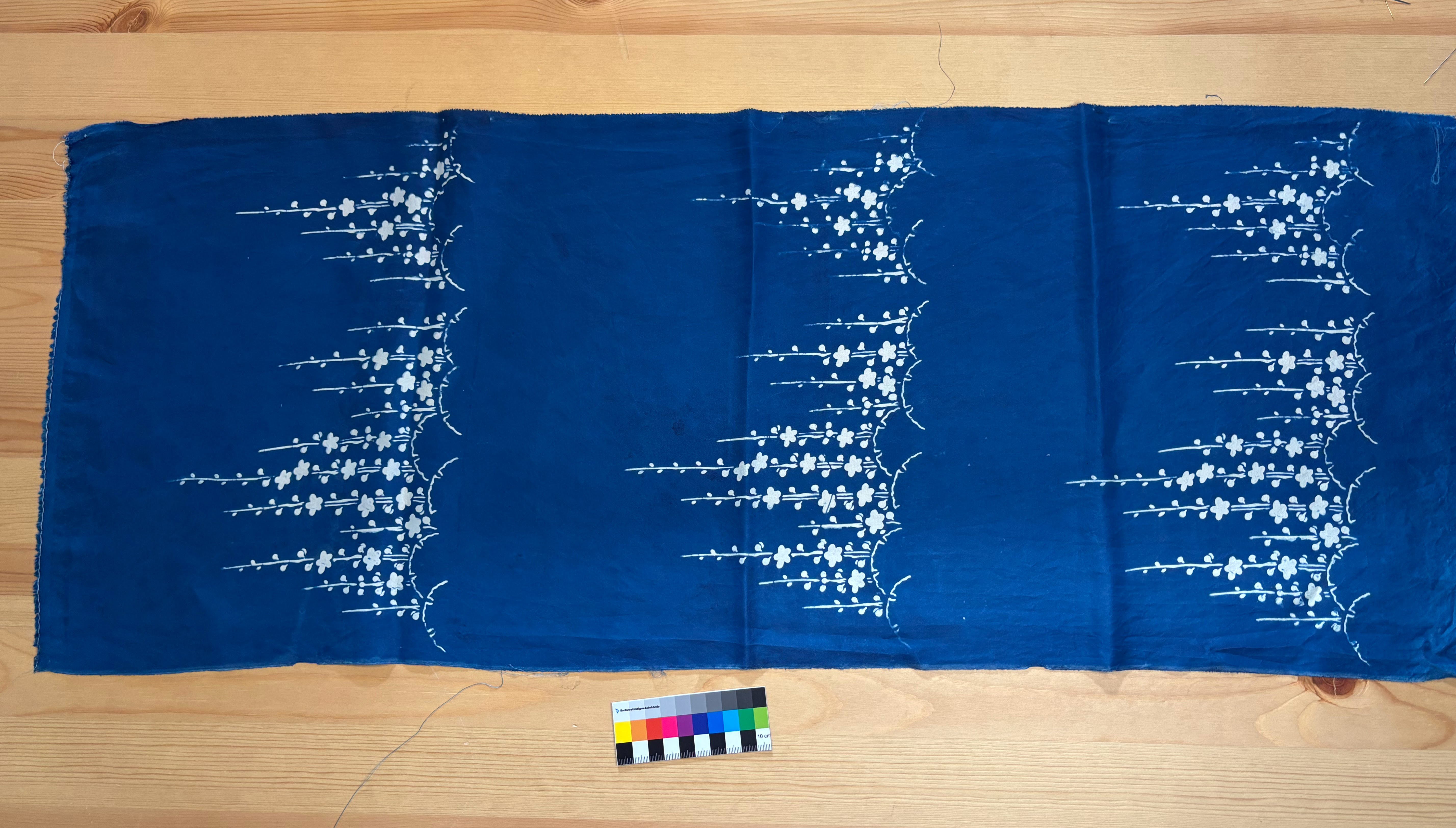
And this is the same pattern (in the same vat) with a single sided resist:


You can see how different the color is. Something interesting to explore would be to cut two stencils, selecting only certain elements of the parent stencil to resist on the second side. For example: for the above motif, you could make the blossoms on the branches resisted on both sides, but resist the branches on just one side. This would make the blossoms a clean white, with an attention catching contrast, while the branches would appear softer. It would be a good way to direct the viewer’s attention across the design.
Here are some additional comparisons with handkerchief weight hemps and linens. These pieces of fabric were mixed vats trials (some pieces are dipped in natural indigo, some are synthetic indigo, some are mixed).


Here’s another set of trials in handkerchief weight hemp. They were given one dip in a natural indigo powder, fructose reduced, and the second dip in synthetic (chemical) indigo powder, thiox reduced.


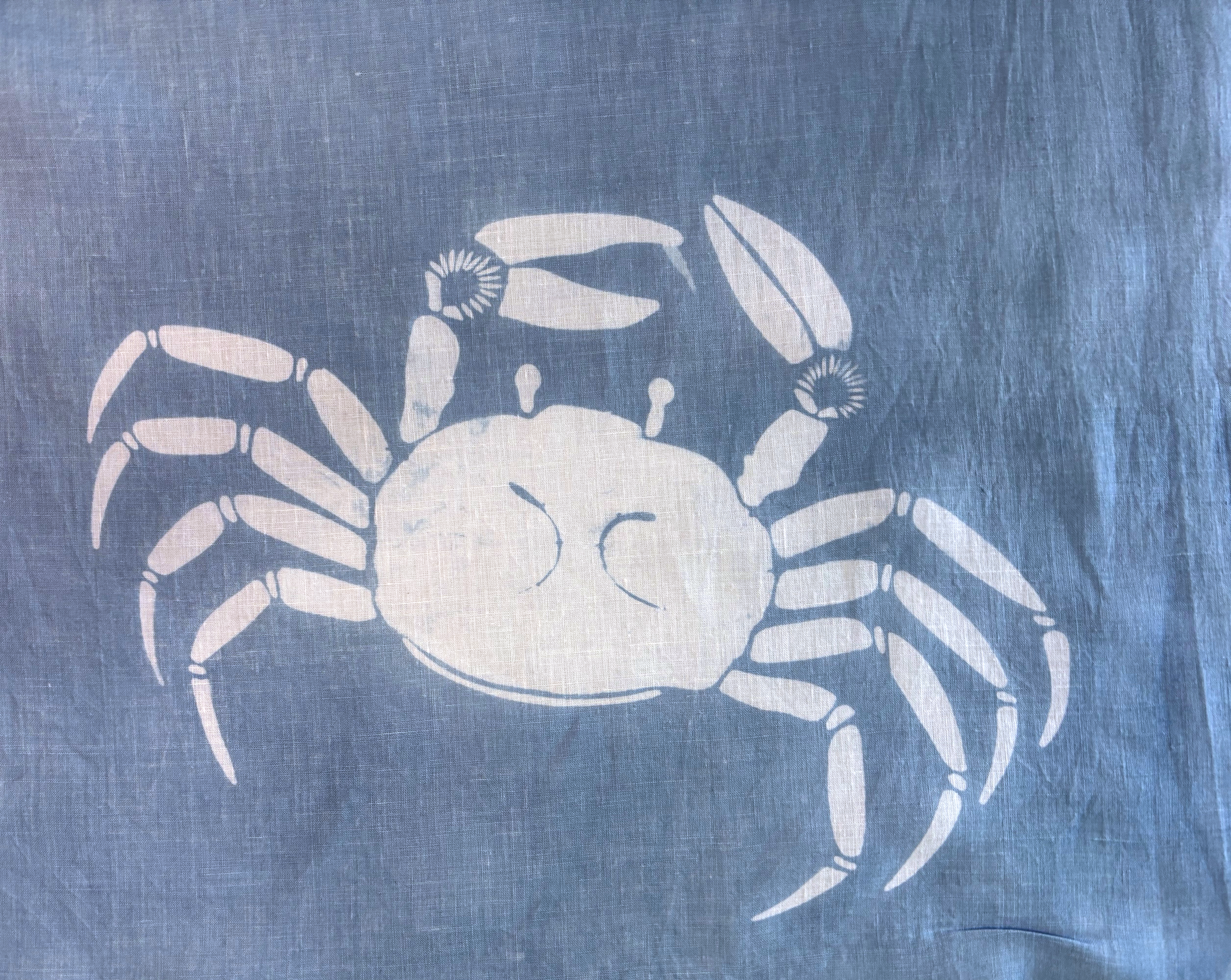
One disadvantage of the single sided resist is that it does not seem to hold up for as long in the vat. I can’t say precisely how long the difference is, but I had some test pieces that were both single and double sided resisted, and the single sided failed while the double sided paste remained intact.
You can see a good example of this happening in the picture below. The crab on the left is single sided resist, and was cut off the bolt next to it, which is double sided resist. It’s faded because it was used for washfastness testing – I used the damaged crab for washfastness testing because it was unusable as part of a garment. All the speckles and blue areas on the body of the crab are the result of the paste failing early, not from the washfastness testing. Note that the crabs next to it have no paste issues, like speckling or blue areas, because they used double sided resist.
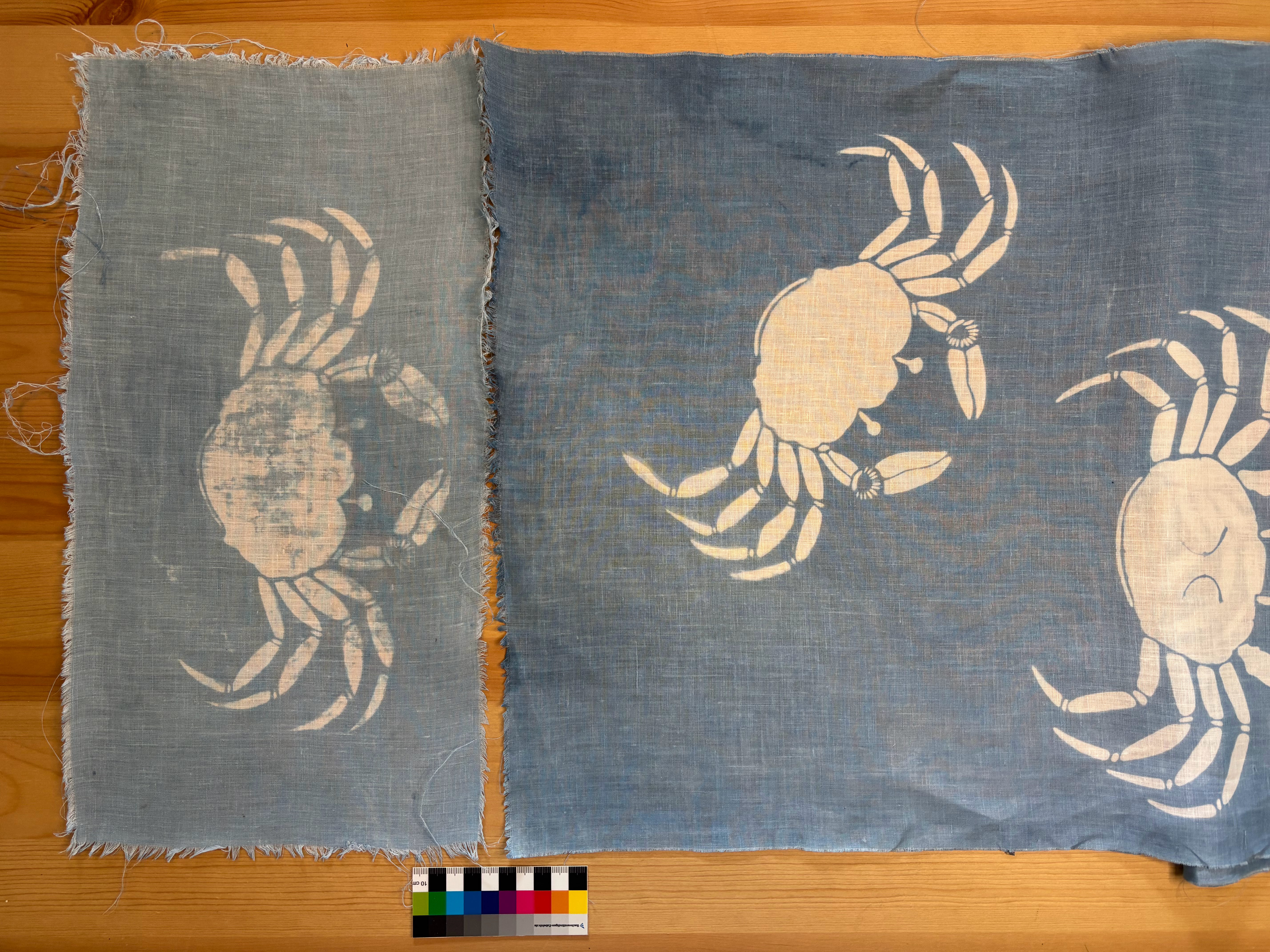
I think having the paste on both sides gives reinforcing protection for both sides. If you want deep, rich color built up from many long dips, it’s worth considering pasting double sided.
In conclusion, both styles of katazome, double and single sided, are valid, traditional, and historical. It would be interesting to explore mixing them for varying shades of blue and white.
It’s important to note that the aesthetics of each style are heavily influenced by the weight and type of the fabric used. Even when only resisted on one side, lighter fabrics with open weaves appear more clear white. With lighter, open weaves, you may be able to skip double sided resist and still get a fairly white resist. Even with tightly woven fabrics like silk habotai, the soft, light blue on the opposite side of single sided resist could be used thoughtfully to great artistic effect.
As always, I recommend testing on a swatch before committing to a large piece. Personally, I myself enjoy the clear, clean white of double sided resist, as well as its challenge. Look for more on that from me in the future.

Leave a Reply